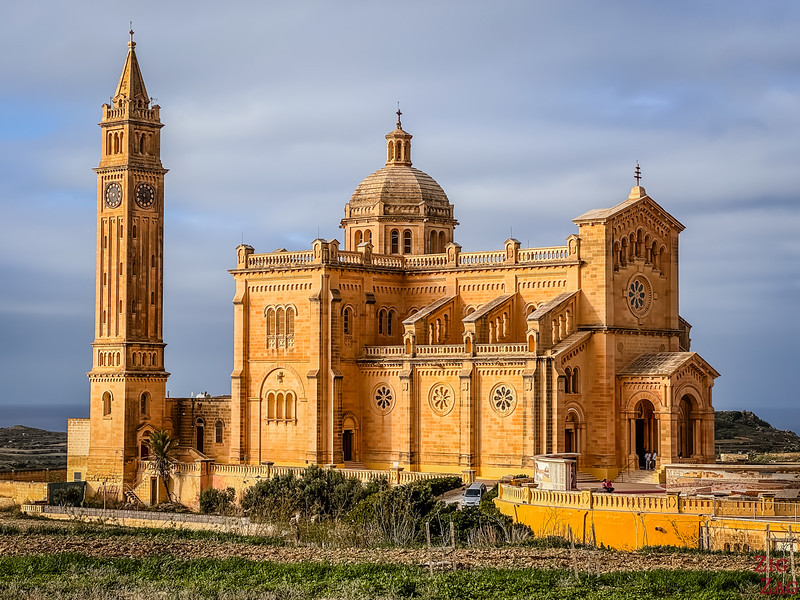
Visiting Gozo? Don’t miss the Ta’ Pinu Basilica, the most famous Marian shrine in the Maltese archipelago. Perched on a hill in the village of Gharb, in the northwest of the island, this imposing neo-Romanesque basilica rises dramatically from the limestone landscape! From the moment I approached, I was struck by the majesty of its honey-coloured stone façade and twin bell towers dominating the surrounding plain.
In this article, you’ll find my photos and all my tips to make the most of your visit to the Ta’ Pinu Basilica.
// On this page, no sponsored content. Just a few affiliate links.
// If you use them, I’ll get a commission at no extra cost to you (read more).
Why visit the Ta’ Pinu Basilica?
Is the Ta’ Pinu Basilica worth it? My verdict:
Yes, the Ta’ Pinu Basilica is absolutely worth a visit. Whether you’re a believer or simply a lover of religious heritage, this shrine offers a singular experience that moves visitors as much through its architectural beauty as through the atmosphere of quiet contemplation it exudes.
It is one of the most beautiful visits to make on the island of Gozo and in Malta.
Why is the Ta’ Pinu Basilica famous?
The Ta’ Pinu Basilica owes its fame to a legend dating back to 1883. That year, a woman from Gharb named Karmni Grima heard a mysterious voice calling to her from an old, dilapidated chapel on the outskirts of the village. She told her friend Francesco Portelli, who was seriously ill: he miraculously recovered after praying in the chapel.

A succession of unexplained healings followed, drawing pilgrims from across the Maltese archipelago and beyond. The site’s reputation spread so widely that Pope Pius XI granted it the title of minor basilica in 1932. To this day, Ta’ Pinu remains one of the most visited pilgrimage sites in the central Mediterranean.
My favourite moments
Here are my three personal highlights from this visit:
- Its setting in the Gozitan countryside, and the majestic way it presides over the surrounding landscape.
- Discovering the ex-voto galleries: thousands of letters, photographs, crutches and naive drawings left by the faithful from around the world as testimony to graces received. A deeply touching and unexpected inventory of humanity.
- The exterior circuit of the basilica, combining architecture and panoramic views.

Where to Stay in Malta – My Favorite Spots:
- Valletta – See best-rated accommodations
- St. Julian’s – See best-rated accommodations
- Victoria (Gozo Island) – See best-rated accommodations
My Top Picks:
- Cugo Gran Macina (5 stars) – see photos and availability
- The Gomerino Hotel (4 stars) – see photos and availability
See my article on the best places to stay in Malta (coming soon)
Getting there and map: Ta’ Pinu Basilica, Gharb
Where is the Ta’ Pinu Basilica?
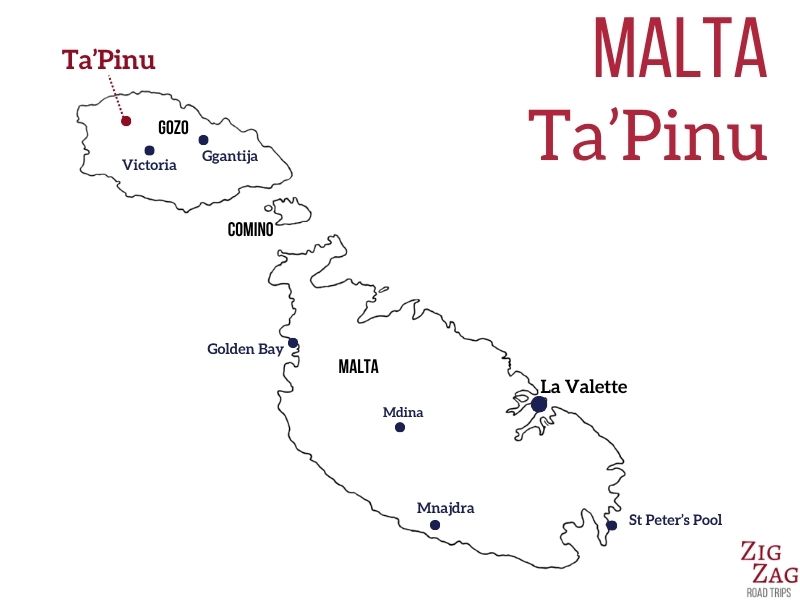
- In the village of Gharb, in the northwest of the island of Gozo (Malta)
- Driving time from Victoria (Rabat), the capital of Gozo: approximately 10 minutes
- Driving time from Mġarr harbour (ferry terminal): approximately 20 minutes
- Driving time from Marsalforn: approximately 15 minutes
- Here is a map to help you find your way:
How to get there?
There are two main options for reaching the Ta’ Pinu Basilica:
- By car or scooter: this is the easiest and most common way to get around Gozo. The shrine is located just outside the centre of Gharb, on a well-signposted road from Victoria. Driving is straightforward, as the roads in this rural area are lightly trafficked. From Malta, you will first need to take the ferry linking Cirkewwa to Mgarr (crossing of approximately 25 minutes), then drive to the basilica. Book your ferry.
- Public transport: bus routes connect Gharb with Victoria. From the village stop, allow a few minutes’ walk to reach the shrine. Check the Malta Public Transport website for up-to-date timetables.
Parking
Free parking is available directly in front of the basilica entrance. Spaces are generally sufficient outside the major religious feast days, particularly around 15 August (the Feast of the Assumption), a period of heavy visitor numbers when it is advisable to arrive early.


My tips for renting a car in Malta
- Compare prices on Discovercars, my favorite platform and one of the highest-rated
- Book your car early for more options and better prices
- Don’t rent a car that’s too big, as the roads are narrow.
Practical tips: duration, opening hours, food…
Best time to visit
The basilica can be visited at any time of year. For a more intimate atmosphere, weekday mornings are ideal, when visitor numbers are lower. Access is restricted during religious celebrations, though it’s not always easy to know in advance whether a wedding or baptism is taking place.
Conversely, if you’d like to experience a collective pilgrimage, the Feast of the Assumption on 15 August is a vibrant and moving highlight. Avoid summer weekends if you’re seeking peace and quiet.

Visit duration and accessibility
Allow between 45 minutes and 1.5 hours for a complete visit, including the main basilica, the 1590 chapel at the rear, and the ex-voto galleries. The site is broadly accessible to visitors with reduced mobility: the main entrance and nave are on a single level. Some secondary spaces may have a few steps; contact the shrine’s reception directly for any specific queries.
Suggested visiting order
There is no prescribed route through the basilica. I suggest starting with the main nave to appreciate the grandeur of the building and the high altar, then making your way to the side galleries to discover the ex-votos. End with the small original chapel, accessible from the rear of the basilica: the transition from the grand to the intimate is particularly striking. Before leaving, take the time to walk around the exterior of the shrine and enjoy the panorama over the hills of Gozo.

Visiting with children + rules
The Ta’ Pinu Basilica lends itself well to a family visit, thanks in particular to the variety of things to see: imposing architecture, ex-voto galleries filled with unusual objects (crutches, photographs, drawings), and the old chapel with its intimate setting. Curious children will naturally be drawn to the many objects left by pilgrims. There is no dedicated educational trail for young visitors, but the shrine is accessible and enjoyable to explore as a family.
Remember to cover shoulders and knees in keeping with the dress code in force.
The requirement for silence may be challenging for some children.

Opening hours and admission
Entry to the Ta’ Pinu Basilica is free. The basilica is generally open daily, morning and afternoon, with a midday closure.
Masses are celebrated on weekdays at 7:30 am, 8:30 am and 6:30 pm, and more frequently at weekends.
Visit the official website for more information here.
Food and drink
There is no catering within the shrine. The village of Gharb, a few minutes’ walk away, offers a handful of options for lunch. For a wider choice, Victoria, the capital of Gozo, is about 10 minutes away by car and has plenty of cafés and restaurants serving local Maltese cuisine.


My favorite activities in Malta:
- Boat trip to Comino Island and the Blue Lagoon – see options
- Kayaking excursions – see options
- Culinary tours – see options
- ATV tours – see options
A neo-Romanesque architecture with a strong character
The façade and bell towers
As you approach the shrine, the façade of the Ta’ Pinu Basilica immediately commands attention. Built in cream-coloured Gozitan limestone, it displays a sober and balanced neo-Romanesque style, dominated by two slender bell towers framing the central gable. I felt that this architectural choice gave the building a solemnity free from excessive austerity, perfectly in harmony with the rural landscape of Gozo. You will notice the rounded arch arcading that punctuates the façade and the central rose window, hallmarks of this style that was very fashionable in religious architecture at the turn of the twentieth century. The ensemble, built between 1920 and 1931, bears witness to the craftsmanship of Gozitan artisans and their mastery of the local limestone.

Stepping through the portal, you move from Mediterranean brightness into the golden half-light of the nave. I was struck by the height of the vaulted ceiling and the quality of the mosaics adorning the walls and ceiling, evoking the great Italian basilicas of the early twentieth century.

The central nave, flanked by two side aisles, draws the eye towards the high altar, surmounted by a painting of the Virgin Ta’ Pinu, an object of veneration for Maltese faithful across generations.
Take the time to observe the details of the capitals and marble columns: every element has been crafted with exceptional care. The atmosphere is conducive to contemplation, whether or not you are a believer.

The soul of the shrine: faith, memory and devotion
The original 1590 chapel
Nestled against the rear of the basilica and seamlessly integrated into the twentieth-century building, the small 1590 chapel forms the historic heart of the shrine. This is where it all began: it was in this modest space that Karmni Grima is said to have heard the mysterious voice in 1883.
I was particularly moved by the contrast between the grandeur of the basilica and this room of almost monastic simplicity, with its rough stone walls. Here you can see the original altar and the image of the Virgin to which Gozitan devotion has been attached for centuries. The chapel, still accessible to the faithful and visitors alike, radiates an atmosphere of remarkable intensity.
Plan your unforgettable trip to Malta!

- maps to help you plan
- handpicked beautiful spots
- Practical information, including GPS coordinates
- photos to help you choose
COMING SOON
The ex-voto galleries
The side corridors of the basilica house one of the most important ex-voto collections in the Mediterranean region. I spent a long time wandering through these galleries, where thousands of offerings left by the faithful since the nineteenth century have accumulated: handwritten letters, yellowed photographs, crutches, prosthetics, naive drawings, model boats, military medals…
Each object tells a story of healing, rescue or unexpected grace. You may be surprised by the diversity of donors’ geographical origins — they come from Malta, but also from Italy, Australia, Canada and Latin America — a testament to the Maltese diaspora scattered to the four corners of the world. A collection of profound humanity, not to be missed.
The forecourt

The forecourt of the Basilica of Our Lady of Ta’ Pinu is itself a masterpiece of sacred art in the open air. This large welcoming space (known locally as the zuntier) offers visitors and pilgrims a visual and spiritual journey through monumental mosaics and remarkable marble sculptures.
The enclosure walls framing the esplanade have been adorned with particularly vibrant contemporary mosaics. They were designed and created by the Centro Aletti (based in Rome), under the direction of the Jesuit theologian and artist Marko Ivan Rupnik. The works were inaugurated around 2017.
These frescoes depict all 20 mysteries of the Rosary (the joyful, luminous, sorrowful and glorious mysteries). The aim is to invite contemplation and prayer even before crossing the threshold of the church.
History in brief
The Ta’ Pinu Basilica is intimately tied to the religious history of Gozo. Here are the key milestones:
- 1575: A first chapel is built on the site by Georġ Dimitri, then gradually falls into disuse.
- 1590: The chapel is rebuilt thanks to the generosity of a local man named Pinu Gauci — hence the name Ta’ Pinu, meaning “of Pinu” in Maltese.
- 1883: Karmni Grima hears a supernatural voice in the chapel. The healing of her friend Francesco Portelli triggers the first accounts of miracles and an influx of pilgrims.
- 1897: The chapel is declared the official Marian shrine of the Diocese of Gozo.
- 1920–1931: Construction of the current basilica in neo-Romanesque style, built in Gozitan limestone around the original chapel, which is carefully preserved.
- 1932: Pope Pius XI raises Ta’ Pinu to the rank of minor basilica.
- 1990: Pope John Paul II personally visits the shrine during his pastoral journey to Malta.

Around the Ta’ Pinu Basilica
The area around Gharb is full of sites that complement a visit to the shrine perfectly.
- The village of Gharb itself deserves a short stroll: its baroque parish church dedicated to the Visitation, its central square and its limestone alleyways have an authentic charm.
- Nearby, the Dwejra headland offers one of the most spectacular coastal panoramas in Gozo, with the Inland Sea, Fungus Rock and cliffs plunging into an intensely blue sea.
For more ideas on what to do on the island, don’t miss my dedicated article on Gozo.
Frequently asked questions
What does the name “Ta’ Pinu” mean?
In Maltese, “Ta'” is a particle meaning roughly “of” or “belonging to”. “Pinu” is the diminutive of “Filippinu”, the first name of a local man called Pinu Gauci who funded the rebuilding of the chapel in 1590. The shrine thus inherited his name, and the expression “Ta’ Pinu” has since referred to this place of Marian devotion on the island of Gozo.
Can you attend Mass at the Ta’ Pinu Basilica?
Yes, Masses are celebrated daily in the basilica. The shrine is an active place of worship, and visitors wishing to attend are welcome, provided they respect the sacred nature of the celebrations. Outside of Mass times, the basilica is open for visits.
You can even watch services online!
Visit the official website for more information here.
Is there a dress code for visiting the basilica?
Yes, as in any Catholic place of worship in Malta and Gozo, respectful attire is required: shoulders and knees must be covered for both women and men. This rule applies inside the basilica and the original chapel. Children are also subject to this dress code.
Plan your trip to Malta!
- Best things to do in Malta
- Best things to do in Gozo
- Most beautiful churches (coming soon)
- Rent a car in Malta
- When to visit Malta (coming soon)
- Where to stay in Malta (coming soon)
- Itineraries: 1 week
Plan your unforgettable trip to Malta!
- maps to help you plan
- handpicked beautiful spots
- Practical information, including GPS coordinates
- photos to help you choose
COMING SOON


