Is Malta worth visiting?
I share here the reasons that convinced me to recommend Malta, along with a few things to know before you go.
// On this page, no sponsored content. Just a few affiliate links.
// If you use them, I’ll get a commission at no extra cost to you (read more).
Is Malta worth visiting?
Yes, absolutely. Malta is a destination unlike any other: a tiny territory that brings together millennia of history, a coastline carved into cliffs, coves and lagoons, and a culture shaped by a dozen successive civilisations. In just a few days, you can go from a 5,600-year-old prehistoric temple to a Baroque city. That is precisely what makes this trip so special.
Nestled in the heart of the Mediterranean, this archipelago of three main islands — Malta, Gozo and Comino — concentrates a density of heritage, landscapes and experiences that few destinations can match. From megalithic temples predating the Egyptian pyramids to UNESCO-listed fortified cities, turquoise waters and vertiginous limestone cliffs, Malta never fails to surprise with its diversity.
Reason 1 — The concentration of experiences in a small territory

This is probably the most immediately convincing argument: Malta is about 27 km long and 14 km wide. Gozo, the second island of the archipelago, is even smaller. Within this compact territory, I discovered prehistoric temples, fortified medieval cities, lagoons with crystal-clear water, cliffs plunging into the sea, internationally acclaimed museums and a gastronomy shaped by centuries of cultural exchange. Everything is accessible without any logistical effort: Valletta can be crossed on foot in 15 minutes, the main beaches in the north are less than an hour from the capital, and the ferry to Gozo takes just 25 minutes.

This compactness is a real advantage for travellers with limited time. In five days, you can cover the major sites of all three islands at a comfortable pace. With a week, you have the luxury of exploring the quieter corners. I never felt like I was rushing from one place to another: the short distances leave time to stop, look around and soak up the atmosphere of each spot.
See my article on all the best attractions or my recommended itinerary for 1 week.
Reason 2 — The cliffs, beaches and coastal scenery

The Maltese coastline is one of the most varied in the Mediterranean for such a small territory. Limestone cliffs alternate with sheltered coves, sandy beaches and rock formations sculpted by the sea over millions of years. I was particularly struck by the Dingli Cliffs on the south-western coast of Malta: they rise to around 253 metres above the sea and form the highest point on the island.

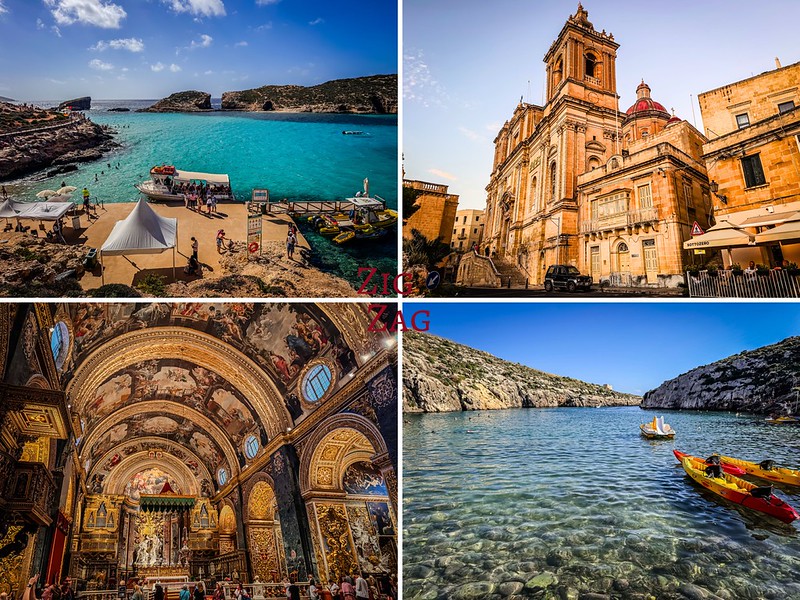
The Blue Lagoon is without doubt the most photographed natural site in Malta. This lagoon with its turquoise, almost transparent water is framed by rocks and the tiny islet of Cominotto. Swimming is very enjoyable, with the sandy bottom making it easy to spot fish clearly. That said, the site is a victim of its own success: in high season (July–August), it can get very busy by midday.
Sun loungers and parasols are available to rent on site, but they go quickly. Remember to bring your snorkelling gear. Different types of boats can take you there – see options

Sandy beaches are relatively rare in Malta — the coastline is mostly rocky — which makes them all the more appreciated. Golden Bay in the north-west is tucked between clay cliffs in warm earthy tones. Ramla Bay on the north coast of Gozo stands out for its deep orange sand, unique in the archipelago. For lovers of wild coves, San Blas, accessible only on foot, offers rare tranquillity in high season.
The salt pans of Xwejni Bay on the north coast of Gozo form a geometric landscape carved into the rock: these basins, in use since Roman times, are still active today, and you can buy sea salt directly from the producers on site.

Where to Stay in Malta – My Favorite Spots:
- Valletta – See best-rated accommodations
- St. Julian’s – See best-rated accommodations
- Victoria (Gozo Island) – See best-rated accommodations
My Top Picks:
- Cugo Gran Macina (5 stars) – see photos and availability
- The Gomerino Hotel (4 stars) – see photos and availability
See my article on the best places to stay in Malta (coming soon)
Reason 3 — The prehistoric sites, unique in the world

This is one of the most unexpected aspects of Malta for many visitors: the archipelago is home to some of the oldest megalithic monuments in the world. The Maltese temples, dated between 3600 and 2500 BC, predate the Egyptian pyramids and Stonehenge in England. Several of them are listed as UNESCO World Heritage Sites.
I found that this historical depth gave the trip an unexpected dimension, well beyond the seaside image of the destination.
The temples of Ħaġar Qim and Mnajdra on the south coast of Malta are the most accessible examples. Ħaġar Qim impresses with the size of its limestone blocks, some of which exceed 5 metres in length. Mnajdra, a few hundred metres further down the slope, is oriented so that sunlight illuminates the interior of the temple at the equinoxes and solstices.
If you would rather not drive, a number of organised tours will take you there – see options

On Gozo, the Ggantija temples (around 3600 BC) rank among the oldest known free-standing structures: their outer walls, over 5 metres high, are made of blocks some of which weigh more than 50 tonnes. Most tours around Gozo include a stop at the temples – see options
The Ħal Saflieni Hypogeum is in a category of its own. This underground temple, carved into the rock across three levels between 4000 and 2500 BC, served both as a place of worship and a necropolis.
Reason 4 — Valletta and the 3 Cities, rich in heritage and life

Founded in 1566 by the Knights of the Order of St John, Valletta is one of the most heritage-dense capitals in the world. Listed as a UNESCO World Heritage Site, it can be explored entirely on foot. I was struck by the concentration of monuments packed into its narrow streets: a sculpted façade, a colourful wooden balcony, a Baroque church at every corner. The city is compact — you can walk it from end to end in 15 minutes — which makes every sight easily accessible.

St John’s Co-Cathedral is the most impressive monument. Built between 1573 and 1578, its plain façade gives nothing away of the Baroque extravagance inside: walls and ceiling covered in paintings and gilding, floor made up of more than 400 polychrome marble tombstones. The oratory houses two major works by Caravaggio, painted during his stay in Malta in 1608. The Grand Masters’ Palace on Republic Street, meanwhile, offers State rooms adorned with frescoes and an armoury of more than 5,000 pieces.

Beyond its heritage, Valletta is also a vibrant city, with restaurants, cafés and markets well worth lingering over.

My tips for renting a car in Malta
- Compare prices on Discovercars, my favorite platform and one of the highest-rated
- Book your car early for more options and better prices
- Don’t rent a car that’s too big, as the roads are narrow.
Reason 5 — The island of Gozo, more rural and authentic

Gozo, the second island of the archipelago, is reached by a 25-minute ferry from the port of Ċirkewwa in the north of Malta. The contrast with the main island is immediate: the pace is slower, the landscapes more rural, the atmosphere more local. I found that Gozo deserved at least a full day, more if you want to explore its different facets.

Victoria, the main town, is dominated by its Citadel, perched on a fortified promontory. Inhabited since the Neolithic period, it was reinforced by the Knights of the Order in the 17th century. Until 1637, the people of Gozo were required to take refuge there every night to protect themselves from pirate raids. From its ramparts, the 360° panorama over the entire island is one of the finest in the archipelago. Inside, several small museums are worth a visit: archaeology, folk arts, old prisons.
See my article on the best attractions in Gozo.
Reason 6 — The medieval fortified cities

Malta has several exceptionally well-preserved fortified cities. Mdina, perched on a hill in the centre of the island, is the former capital. Nicknamed “the Silent City”, it is home to fewer than 300 permanent residents. Its cobbled lanes wind between golden limestone palaces and discreet chapels, in a rare and peaceful quiet. I recommend going early in the morning, before the tour groups arrive. The limestone takes on golden hues in the sunlight, and every turn brings a discovery: a sculpted door knocker, a religious niche, a hidden courtyard.

On the other side of the Grand Harbour, facing Valletta, the Three Cities — Vittoriosa (Birgu), Senglea (Isla) and Cospicua (Bormla) — were the first place of settlement for the Knights of the Order in Malta in 1530. The atmosphere is very different from the capital: more residential, less touristy. I enjoyed wandering through their streets without a fixed route, discovering historic façades and views over the harbour as I went.
Reason 7 — The richness of its culture and traditions

Malta has been shaped by a succession of Phoenician, Roman, Arab, Norman, Spanish, French and British influences over more than three millennia. This layering is visible in everyday life: in the Maltese language, Arabic in origin but written in the Latin alphabet with numerous borrowings from Italian and English; in the architecture, which blends Mediterranean Baroque with Anglo-Saxon elements; in the gastronomy, which combines Sicilian and North African influences. I found this cultural layering particularly visible and fascinating to observe in day-to-day life.

A few things not to miss: the luzzu, brightly coloured fishing boats adorned with the Eye of Osiris at the prow, seen mainly in Marsaxlokk, the island’s most emblematic fishing village. The food is also worth exploring: pastizzi (flaky pastries filled with ricotta or mushy peas, sold for a few cents in pastizzerias), ftira (a topped flatbread similar to focaccia) and rabbit stew, the national dish known as fenkata, are all specialities to try. It is also worth noting that the Catholic faith is ever-present: Malta has more than 360 churches for 316 km², a figure that speaks volumes about the place of religion in local life.

My favorite activities in Malta:
- Boat trip to Comino Island and the Blue Lagoon – see options
- Kayaking excursions – see options
- Culinary tours – see options
- ATV tours – see options
Reason 8 — The water activities

With its clear waters, underwater caves and accessible wrecks, Malta is a prime destination for water activities. Underwater visibility regularly reaches 30 metres, and water temperature ranges from 15°C in winter to 26°C in summer. Whether you are a beginner or experienced, the options are varied and conditions are favourable for much of the year.

Activities not to miss:
- Scuba diving: Malta has many renowned dive sites, including the wreck of the MV Karwela off Gozo (a ferry deliberately sunk to create an artificial reef), the Blue Hole at Dwejra, and the underwater caves of Comino. Dive centres offer introductory dives and excursions for all levels.
- Snorkelling: The best spots include the Blue Lagoon at Comino, Għar Lapsi, Saint Peter’s Pool and Xlendi Bay in Gozo. The clarity of the water allows you to observe many species without having to dive deep.
- Kayaking: Sea kayak excursions allow you to explore caves and coves inaccessible by road, particularly around Comino, the Dingli Cliffs and the south coast of Gozo.
- Stand-up paddleboarding and jet-skiing: Available at the main seaside resorts such as St Julian’s, Sliema and Mellieħa.
A few downsides of a trip to Malta
Crowds in high season
July and August attract the majority of visitors, and the most popular sites feel the impact noticeably. I found that arriving early in the morning or late in the afternoon makes a radical difference at most sites.
Spring (April–June) and autumn (September–November) remain the most pleasant periods: temperatures between 20 and 28°C, moderate crowds and gentler prices.

Traffic and transport
Getting around Malta by car takes some adjustment: driving is on the left (a legacy of the British period, which ended with independence in 1964), roads are sometimes narrow and signage can be inconsistent. Traffic density in urban areas, particularly around Valletta and Sliema, can make some journeys longer than expected. The bus network covers the entire main island with Valletta as the central hub. Fares are affordable, but frequencies can be irregular outside of peak season. For more remote sites such as the southern temples or the Dingli Cliffs, a hire car remains the most practical option.
See my articles: Renting a car and driving in Malta.
Access to certain high-demand sites
The Ħal Saflieni Hypogeum limits entry to 80 visitors per day to preserve the site. In practice, time slots book up several weeks in advance during high season. If this visit is on your priority list, I recommend reserving as soon as your dates are confirmed, even before finalising the rest of your itinerary.
Where to go in Malta

For a first trip, I recommend basing yourself on the main island — Valletta, Sliema or St Julian’s are well situated — and dedicating at least one day to Gozo. Half a day is enough for Comino if you are going mainly for the Blue Lagoon, but allow more if you want to hike around the island.
- With 5 days: Valletta and the Three Cities (2 days), Mdina and the southern temples (1 day), Gozo (1 day), Comino and the beaches (1 day).
- With a week: add the Dingli Cliffs, the Xwejni salt pans, and take time to linger in Gozo.
- With 10 days or more: explore the archaeological sites at your own pace, hike the coastal paths and discover the lesser-known villages.
Plan your trip to Malta!
- Best things to do in Malta
- Best things to do in Gozo
- Most beautiful churches (coming soon)
- Rent a car in Malta
- When to visit Malta (coming soon)
- Where to stay in Malta (coming soon)
- Itineraries: 1 week
Plan your unforgettable trip to Malta!

- maps to help you plan
- handpicked beautiful spots
- Practical information, including GPS coordinates
- photos to help you choose
COMING SOON


