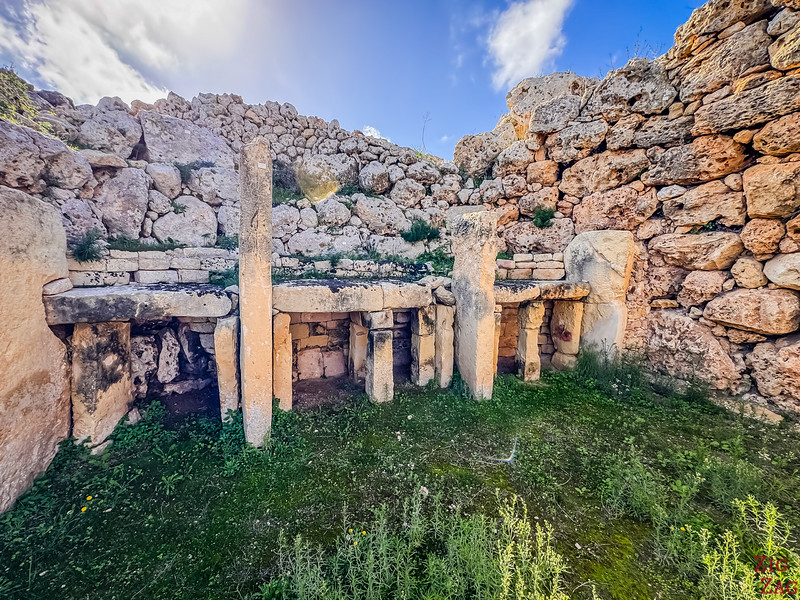
Discovering Gozo? The Ggantija Archaeological Park is a must-see stop. These megalithic temples, built over 5,500 years ago, are among the oldest religious structures in the world. I was struck by the monumentality of these colossal stones, arranged with a precision that still defies understanding today.
In this article, find my photos and all my tips to make the most of your visit to the Ggantija Archaeological Park.
// On this page, no sponsored content. Just a few affiliate links.
// If you use them, I’ll get a commission at no extra cost to you (read more).
Why visit the Ggantija Archaeological Park?
Is the Ggantija Archaeological Park worth it? My verdict:
Absolutely. The Ggantija Archaeological Park is a site of exceptional historical significance. I was struck by the scale of the temples, whose stones weigh several tonnes, and by the reflection they inspire on the capabilities of prehistoric societies.
The adjacent interpretation centre enriches the visit and allows you to place each element in its archaeological context. It is one of the best activities in Gozo. The site is a UNESCO World Heritage Site.
It is one of the must-sees of Gozo and visiting one of the archaeological sites is also one of the highlights of Malta.

Why is the Ggantija Archaeological Park famous?
Ggantija owes its fame to the exceptional age of its two temples, dated to around 3,600 to 2,500 BCE. Older than Stonehenge!
Listed as a UNESCO World Heritage Site in 1980 along with other Maltese megalithic temples, they are considered the oldest free-standing religious buildings in the world. Their name comes from the Maltese word ġgant, meaning “giant” — a direct reference to the coral and limestone blocks used in their construction, some of which exceed five metres in height. Local legend has it that a giantess built them in a single night.

My favourite moments
Here are my top 3 highlights of the visit:
- Discovering the two temples side by side, whose state of preservation left me speechless. Some stones have remained in place for more than five millennia.
- The interpretation centre, which puts into perspective the social organisation and beliefs of the builders of Ggantija through scale models, archaeological objects and accessible explanations. It is a very well-made and interactive museum!
- The view over the Gozitan countryside from the surroundings of the site: a magnificent panorama far from the tourist bustle.


Where to Stay in Malta – My Favorite Spots:
- Valletta – See best-rated accommodations
- St. Julian’s – See best-rated accommodations
- Victoria (Gozo Island) – See best-rated accommodations
My Top Picks:
- Cugo Gran Macina (5 stars) – see photos and availability
- The Gomerino Hotel (4 stars) – see photos and availability
See my article on the best places to stay in Malta (coming soon)
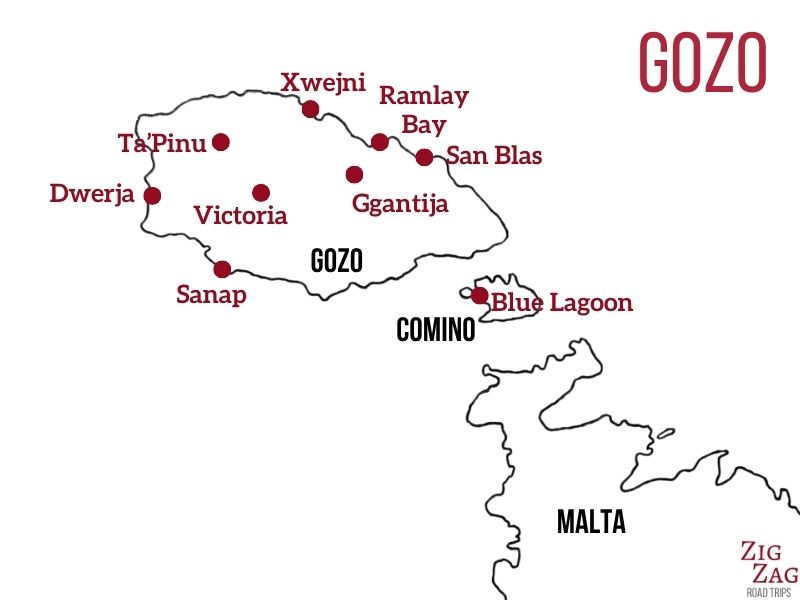
Access and map: Ġgantija Archaeological Park, Xagħra
Where is the Ġgantija Archaeological Park?
- In the village of Xagħra, on the island of Gozo (Malta)
- Driving time from Victoria (Rabat), capital of Gozo: approximately 10 minutes
- Driving time from Mġarr harbour (ferry terminal): approximately 15 minutes
- Driving time from Valletta (after the ferry crossing): approximately 1h30
- Here is a map to help you find your way:
How to get there?
There are several options for reaching the site:
- By car: this is the most flexible way to explore Gozo. The site’s car park is accessible and free. From the port of Mgarr, follow signs towards Xagħra.
- By bus: Gozo’s public transport network serves Xagħra. The nearest bus stop to the Ggantija Archaeological Park is only a 2-minute walk from the site. Check timetables with Malta Public Transport.
- By ferry: to reach Gozo from Malta, take the ferry between Cirkewwa and Mgarr. The crossing takes approximately 25 minutes. Ferries run regularly throughout the day.
- Most excursions around Gozo from Malta include a stop at the temples – see options

Parking
A car park is available directly on site, with spaces reserved for people with reduced mobility. Access by car from the centre of Xagħra is easy and well signposted.

My tips for renting a car in Malta
- Compare prices on Discovercars, my favorite platform and one of the highest-rated
- Book your car early for more options and better prices
- Don’t rent a car that’s too big, as the roads are narrow.
Useful tips: duration, opening hours, food…
Best time to visit
The site can be visited year-round, but the period between March and October has the longest opening hours (10am–6pm). To avoid the Gozitan summer heat and visitor groups, I would recommend visiting early in the morning, right at opening time. The months of April, May and October offer a particularly pleasant climate for exploring the open-air site at your own pace.
In July and August, bring adequate sun protection and a bottle of water, as part of the visit takes place outdoors.

Visit duration and main practicalities
Allow between 1 and 1h30 to comfortably visit the site and its interpretation centre. The archaeological park is fully accessible to people with reduced mobility: adapted toilets, reserved parking spaces and specific facilities are provided for this purpose.
The ground around the temples is partly paved, but some areas remain on natural terrain. I therefore recommend closed, sturdy footwear. On site, you will also find luggage lockers as well as a baby-changing area.

Recommended visiting order
I recommend starting with the interpretation centre, located at the site entrance, before heading to the temples. This preliminary step helps you understand the spatial organisation of the two buildings, their probable function and the context of the archaeological excavations. You will then approach the visit of the temples themselves with useful reference points. The site map is available at reception.
Visiting with children
It is a site well suited to children. The site has a dedicated children’s area and the interpretation centre offers illustrated panels accessible to younger visitors; the museum is very interactive.
The monumental scale of the stones and the legendary tales linked to giants generally captivate children’s imagination very well. Baby-changing facilities are also available on site.

Opening hours and admission prices
- From 1 March to 31 October 2026, the Ġgantija Archaeological Park is open every day from 10am to 6pm.
- Closes at 5 p.m. in winter
- Prices: adults (18 and over): €10; young people (12–17): €8; seniors (60 and over): €8; concessions and students: €8; children (6–11): €6; children aged 1 to 5: free.
- Heritage Malta members and Heritage Malta Passport holders enter free of charge.
- You can purchase tickets online; booking on the official website is mandatory.
- Visit the official website for more information here.
Guided tours
The site does not offer regular guided tours in English, but the interpretation centre panels are detailed enough to allow for a rewarding self-guided visit. Ask at reception upon arrival about any options that may be available during your visit. Visit the official website for more information here.

Food and drink
The Ġgantija Archaeological Park has an on-site refreshment area, with drinks and food available for purchase. Indoor and outdoor rest areas allow you to take a break before or after the visit.
For a more substantial lunch break, the village of Xagħra, a few minutes’ walk away, offers several restaurants and cafés.
Plan your unforgettable trip to Malta!

- maps to help you plan
- handpicked beautiful spots
- Practical information, including GPS coordinates
- photos to help you choose
COMING SOON
The temples of Ġgantija: two prehistoric sanctuaries
The South Temple
The South Temple is the oldest of the two buildings in the Ġgantija complex. Built around 3,600 BCE, it is also the best preserved. I was impressed by the height of some of the coral blocks still standing, which in places reach more than five metres.

The building’s layout follows an apsidal arrangement: semi-circular spaces disposed symmetrically on either side of a central corridor. This structure, characteristic of Maltese megalithic architecture, suggests a ritual or religious use. Traces of animal offerings and ceremonial activities were uncovered during excavations. Pause at the entrance threshold, whose worn stones bear witness to the passage of generations of worshippers.

The North Temple
Adjoining the South Temple but slightly more recent — dated to around 3,000 BCE — the North Temple has a similar layout, with five apses organised around a central axis. I found it interesting to compare the two structures side by side: you can perceive an evolution in the mastery of stoneworking, with more carefully worked surfaces in the North Temple.

Niches carved into the walls suggest they were used to place offerings or votive statuettes. Look carefully at the temple’s outer walls: the large stones, some of local limestone, were assembled with remarkable precision by builders who had no metal tools at their disposal.
The interpretation centre: understanding Ġgantija
Opened in 1992 and managed by Heritage Malta, the interpretation centre provides a valuable introduction to visiting the temples. I spent a good half-hour there, taking in the essential information on the site’s chronology, construction techniques and hypotheses about the society that built Ggantija.

You will discover: scale models, authentic archaeological objects including statuettes and pottery uncovered on the site, and multilingual explanatory panels.
You will particularly appreciate the illustrated reconstruction of the construction site, which gives a concrete idea of the collective organisation needed to move and erect these blocks weighing several tonnes. The centre is fully accessible to people with reduced mobility, with adapted facilities and a gift shop to round off the visit.

I loved the interactive side of the museum where you could touch reproductions, make comparisons and have a bit of fun.

My favorite activities in Malta:
- Boat trip to Comino Island and the Blue Lagoon – see options
- Kayaking excursions – see options
- Culinary tours – see options
- ATV tours – see options
The views and the village of Xagħra
The site also offers beautiful views of the Gozitan countryside all around, and of the neighbouring village.
It is called Ix-Xagħra.
You will also find:
- underground caves
- other small ruins
- the church of Xagħra, whose dome is clearly visible from the temples

History in brief
The history of Ggantija spans millennia and can be read in every stone of this fascinating site. Here are the key milestones:
- Around 3,600 BCE: Construction of the South Temple of Ggantija, the older of the two, by prehistoric communities on the island of Gozo.
- Around 3,000 BCE: Construction of the North Temple, slightly more recent but equally imposing.
- Between 2,500 and 2,400 BCE: Abandonment of the temples, the exact reasons for which remain unknown. Some archaeologists point to a depletion of natural resources or social upheaval.
- 1827: First archaeological excavations carried out under the direction of Otto Bayer, uncovering the structure of the two temples.
- 1980: Inscription of the megalithic temples of Malta, including Ggantija, on the UNESCO World Heritage List.
- 1992: Opening of an interpretation centre enabling visitors to better understand the archaeological and cultural context of the site.
Frequently asked questions
Do you need to book before visiting Ġgantija?
Yes, online booking is mandatory. You can save time by purchasing tickets on the official Heritage Malta platform.
Is Ġgantija more interesting than the temples on the island of Malta?
Ggantija shares with the other Maltese megalithic temples — Ħaġar Qim, Mnajdra and Tarxien — a joint UNESCO World Heritage listing and a similar period of construction. What sets Ggantija apart is its isolation on the island of Gozo, which gives it a more unspoilt atmosphere, and the remarkable state of preservation of its outer walls.
For travellers who wish to combine culture with exploring the island of Gozo, Ggantija is an unmissable stop. The two destinations are complementary rather than competing.
Plan your trip to Malta!
- Best things to do in Malta
- Best things to do in Gozo
- Most beautiful churches (coming soon)
- Rent a car in Malta
- When to visit Malta (coming soon)
- Where to stay in Malta (coming soon)
- Itineraries: 1 week
Plan your unforgettable trip to Malta!
- maps to help you plan
- handpicked beautiful spots
- Practical information, including GPS coordinates
- photos to help you choose
COMING SOON


