The fortified alleyways of Valletta or the peaceful countryside of Gozo? The cliffs of Dingli or the inland sea of Dwejra? The underground temples of the Hypogeum or the giants of Ggantija?
If you’re planning a trip to Malta, the question arises: should you stay on the main island or on Gozo?
Here are all my opinions and comparisons to help you choose based on your preferences and travel style.
// On this page, no ads, no sponsored content. Just a few affiliate links.
// If you use them, I’ll get a commission at no extra cost to you (read more).
Malta or Gozo? Summary
Two islands, two vibes
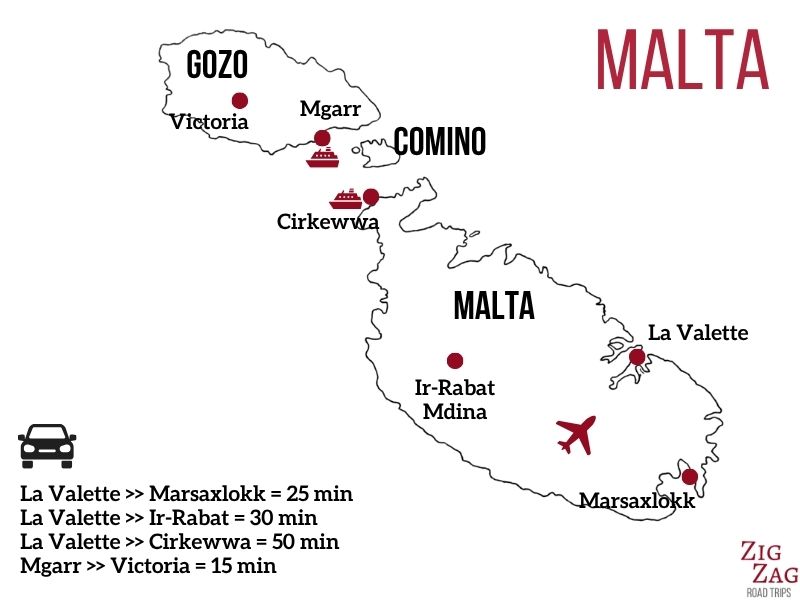
Before comparing, it’s useful to locate the two islands. The Maltese archipelago consists of three islands: Malta (the largest, 246 km²), Gozo (67 km²) and tiny Comino in between.
Malta is home to most of the population, the main towns (Valletta, Sliema, St Julian’s, Mdina) and the tourist infrastructure. Gozo, accessible in 25 minutes by ferry from Cirkewwa, is more rural, quieter and greener. I felt the difference as soon as I stepped off the ferry at Mgarr: the pace changes immediately.
Malta or Gozo – the showdown

Here’s a summary of my opinions after exploring both islands in detail:
- Historical heritage and museums: Malta, significantly richer (Valletta, Mdina, the Three Cities, the Hypogeum)
- Best beaches: Gozo – the sandy beaches are more distinctive (Ramla Bay, San Blas)
- Natural sites: Gozo, thanks to Dwejra, the Sanap cliffs and the Xwejni salt pans
- Prehistoric sites: tie – Ggantija on Gozo, Hagar Qim/Mnajdra and the Hypogeum on Malta
- Activities and nightlife: Malta, far more options (water sports, going out, parks)
- Peace and authenticity: Gozo, without hesitation
- Food: tie – the same Maltese specialities, but Gozo retains a more artisanal character (the ftira is thicker, the gbejna cheese fresher)
- Day trip to Comino: Gozo, the crossing is shorter (about 10 min vs 25–30 min from Malta)
- Ease of getting around: Malta, better served by buses and infrastructure
Where to stay?
At the end of the article, you’ll find my tips on where to stay on each island.
But if you already have an idea:

On the island of Malta
- Valletta – ideal for heritage and culture
See top-rated accommodation - St Julian’s / Sliema – for nightlife and restaurants
See top-rated accommodation - Mellieha – for beaches and access to the Gozo ferry
See top-rated accommodation
On Gozo
- Victoria – centrally located, convenient for exploring everything
See top-rated accommodation - Marsalforn – for coves and swimming
See top-rated accommodation
Malta or Gozo: where are the best beaches?
Let’s start with a common question. Malta is not a classic beach destination: the coastline is mostly rocky. However, both islands have sandy beaches and coves worth visiting. In my opinion, the most striking beaches are on Gozo.
Malta’s beaches
On the main island, the sandy beaches are concentrated along the north-west coast.
Golden Bay

Golden Bay is one of Malta’s most popular beaches. Its golden sand, nestled between clay cliffs, makes it a photogenic spot, especially at sunset. The beach is lifeguarded in season and has a few amenities (sun loungers, snack bars). It fills up quickly in summer, especially at weekends.
Mellieha Bay (Ghadira)

Mellieha Bay is Malta’s largest sandy beach. The water is shallow for a good distance, making it well suited to families. The beach is convenient thanks to the many services on site, even if the setting is less wild than Gozo’s beaches.
Paradise Bay

Paradise Bay is a small cove reached by steps carved into the rock at the northern tip of the island. The water is an intense blue, and the view looks straight out to Comino and Gozo. It’s a good compromise between accessibility and natural surroundings.
Gozo’s beaches
Gozo has fewer sandy beaches, but the ones that exist have far more character. Because I love beaches with interesting natural surroundings.
Ramla Bay

Ramla Bay is widely considered the most beautiful beach in the archipelago. Its deep orange sand, unique in Malta, stands out at first glance. The bay is framed by green hills and overlooked by the ruins of a Roman fortress.
San Blas

San Blas is only accessible on foot via a steep path with about a 10-minute descent. The sand is a reddish-orange, framed by dense vegetation and clay cliffs. I fell in love with this cove and its rock formations. The climb down deters some visitors, which helps preserve the tranquillity of the place.
Mgarr ix-Xini

Mgarr ix-Xini is a narrow inlet wedged between two cliffs on Gozo’s south coast. The water is crystal clear and the tranquillity of the spot contrasts sharply with the busier beaches in the north of the island. It’s an excellent snorkelling spot. The bottom is rocky: bring water shoes!
And also: Saint Peter’s Pool, Malta’s natural swimming pool

On Malta, Saint Peter’s Pool (near Marsaxlokk) is a natural swimming pool carved into the limestone. The water is a deep blue, and the flat rocks around it serve as a sunbathing spot. The more adventurous jump off the rocky ledges for a swim. Access is free but there are no facilities. Bring suitable shoes for the rocks and allow about 10 minutes on a dirt path from the car park.

My tips for renting a car in Malta
- Compare prices on Discovercars, my favorite platform and one of the highest-rated
- Book your car early for more options and better prices
- Don’t rent a car that’s too big, as the roads are narrow.
Read all my tips (coming soon)
Malta or Gozo: where are the best historical sites?
This is where the difference is most striking. Malta has a density of historical heritage that is rare for such a small territory. Gozo holds its own thanks to the Citadel of Victoria, but the main island clearly dominates in this area.
The island of Malta: a concentrate of history

Valletta is an open-air museum in its own right. Founded in 1566 by the Knights of the Order of St John, the capital is a UNESCO World Heritage Site. I was struck by the density of monuments packed into its narrow streets: every corner holds a discovery. Among the highlights:
- St John’s Co-Cathedral, built between 1573 and 1578, whose austere façade gives nothing away about the profusion of baroque decoration inside. The oratory houses two major works by Caravaggio, painted during his stay in Malta in 1608. Allow 1 to 1.5 hours for the visit. See guided tour options.
- The Upper Barrakka Gardens, which offer the finest view from Valletta over the Grand Harbour and the Three Cities. Every day at noon and 4 pm, the Saluting Battery fires a cannon from the platform below.
- The Grand Master’s Palace, former official residence of the Order’s leaders, whose armoury houses more than 5,000 pieces from the 15th to the 18th century. Take advantage of the combo ticket.
- Fort St Elmo, at the tip of the peninsula, which traces Malta’s military history.

Beyond Valletta, Mdina (nicknamed “the Silent City”) is Malta’s former capital, perched on a hill in the centre of the island. Fewer than 300 people still live there. Its cobbled lanes wind between golden limestone palaces and discreet churches. Several scenes from the series Game of Thrones were filmed here. Nearby, the St Paul’s Catacombs in Rabat form an underground network carved out between the 4th and 9th centuries.
The Three Cities (Vittoriosa, Senglea, Cospicua), facing Valletta, complete the picture. I found the atmosphere very different from the capital: more local, less touristy. Fort St Angelo played a central role during the Great Siege of 1565, when the Knights held out against the Ottoman Empire’s assault for nearly four months.
Book a guided boat tour of the Three Cities.
The island of Gozo: the Citadel and Victoria

On Gozo, the Citadel of Victoria dominates the island from its fortified hilltop. The ramparts offer a 360° panoramic view over Gozo and, on a clear day, over Malta and Comino. I was impressed by the quality of the recent restoration.
Inside the Citadel, the Cathedral of the Assumption (1697–1711) will surprise you with its trompe-l’œil ceiling painted by Antonio Manuele, which creates the illusion of a dome even though the cathedral doesn’t have one. The effect is stunning when you stand in the centre of the nave.
Below, Republic Street is Victoria’s main shopping street, lined with shops, cafés and traditional bakeries. I enjoyed the relaxed atmosphere.

My favorite activities in Malta:
- Boat trip to Comino Island and the Blue Lagoon – see options
- Kayaking excursions – see options
- Culinary tours – see options
- ATV tours – see options
Malta or Gozo: prehistoric sites
The archipelago has a fascinating prehistoric heritage. The megalithic temples, dated between 3600 and 2500 BCE, are older than the Egyptian pyramids and Stonehenge. Both islands have remarkable sites.
On Malta: Hagar Qim, Mnajdra and the Hypogeum

The temples of Hagar Qim and Mnajdra (UNESCO-listed), on the south coast, overlook the sea. Haġar Qim is my favourite because of the sheer size of its limestone blocks: some exceed 5 m in length. Mnajdra is aligned so that sunlight illuminates the temple interior during the equinoxes and solstices. A path connects the two sites along the cliffs. Allow 1.5 to 2 hours for both.
The Hal Saflieni Hypogeum is an underground temple unique in the world, carved on three levels between 4000 and 2500 BCE. The chambers reproduce underground the shapes of the surface temples, with ceilings decorated with spirals painted in red ochre. Visitor numbers are limited to 80 per day: it is essential to book several weeks in advance. I found this visit exceptional.
On Gozo: the Ggantija temples

The Ggantija temples (UNESCO-listed) are among the oldest freestanding structures in the world, dated to around 3600 BCE. Their name comes from the Maltese “ġgant” (giant), as local legend attributed their construction to a giantess. The outer walls exceed 5 m in height, with some blocks weighing over 50 tonnes. I found the site well presented since its renovation. The adjacent museum explains the building techniques. Allow about 1 hour for the visit.
Most excursions around Gozo include a stop at the temples – see options
Plan your unforgettable trip to Malta!

- maps to help you plan
- handpicked beautiful spots
- Practical information, including GPS coordinates
- photos to help you choose
COMING SOON
Malta or Gozo: the most beautiful natural sites
Both islands offer striking coastal landscapes, but of a different nature. Malta stands out for its vertiginous cliffs and sea caves. Gozo concentrates unique geological formations and more varied scenery within a small area.
Natural sites on Malta
The Dingli Cliffs

The Dingli Cliffs rise to about 253 m above sea level, the highest point in the archipelago. A trail runs along the edge for several kilometres and offers unobstructed views of the Mediterranean and the uninhabited islet of Filfla. The small Chapel of St Mary Magdalene, perched on the cliff edge, is an easily recognisable landmark. I found it an ideal spot for a late-afternoon walk. Access is free.
The Blue Grotto

On Malta’s south coast, the Blue Grotto is a series of sea caves accessible by traditional boat. The light reflecting off the sandy bottom gives the water intensely blue hues. Boat trips last about 25 minutes and depart from the small harbour of Wied iz-Zurrieq. A viewpoint above already offers an impressive vista, even without taking the boat.
See excursions.
Natural sites on Gozo
Dwejra and the Inland Sea

Dwejra, on Gozo’s west coast, is a remarkable geological site. The Inland Sea is a natural lagoon connected to the Mediterranean by a tunnel carved through the cliff. Local fishermen use it to shelter their boats, and boat excursions pass through the tunnel. It is also the former site of the famous Azure Window, a natural arch that collapsed in 2017. I found the site still impressive despite the loss of the arch.
The Sanap Cliffs (Ta’ Ċenċ)
The Sanap Cliffs tower over Gozo’s south coast from a height of over 130 m. These limestone walls plunge vertically into the sea. The plateau at the top is dotted with prehistoric remains: dolmens and cart ruts carved into the rock. I find the views of the cliffs much better here than at Dingli on Malta, because the path lets you see them in profile. The walk is suitable for all levels, but stay cautious near the edge (there are no barriers).
The Xwejni Bay salt pans

On Gozo’s north coast, the Xwejni Bay salt pans form a geometric landscape sculpted into the coastal rock. These basins, in use since Roman times, are still active. Some families carry on the artisanal sea-salt harvest, particularly between June and September. I found the spot very photogenic, especially thanks to the rocks standing out in the background. Access is free.

It’s time to book!
Compare everything: companies, prices, schedules, and availability.
Day trip to Comino: from Malta or Gozo?

Comino is the smallest of the archipelago’s three inhabited islands. Situated between Malta and Gozo, it is virtually deserted: no cars, no paved roads. The island is best known for the Blue Lagoon, a lagoon with turquoise waters framed by rocks and the islet of Cominotto. But Comino also offers little-used hiking trails and the quieter bay of Santa Marija. The island can be explored on foot in 2 to 3 hours.
From Malta
Boats depart mainly from Cirkewwa (in the north of Malta) or from Sliema and Bugibba for organised excursions. The crossing from Cirkewwa takes about 25 to 30 minutes. The advantage: excursions from Malta are more numerous and often include a tour of the Santa Maria caves as well as free time at the Blue Lagoon. If you’re staying in central or southern Malta (Valletta, Sliema, St Julian’s), you need to factor in the journey to the departure point, which can make for a longer day.
Different types of boats can take you there – see options

From Gozo
Boats depart regularly from the port of Mgarr (Gozo). The crossing is much shorter: only about 10 minutes.
Malta or Gozo: activities and atmosphere
Water sports

Both islands offer excellent conditions for water sports. Underwater visibility regularly reaches 30 m and the water temperature ranges from 15°C in winter to 26°C in summer. Diving is renowned across the entire archipelago.
On Malta, the offer is broader: diving, snorkelling, kayaking, stand-up paddling, jet-skiing. The seaside resorts of St Julian’s, Sliema and Mellieħa are home to most operators. The best snorkelling spots include Għar Lapsi and Saint Peter’s Pool.
On Gozo, diving is particularly popular. The Blue Hole at Dwejra, the underwater caves of Comino and the wreck of the MV Karwela (a ferry deliberately sunk to create an artificial reef) are among the best dive sites in the Mediterranean. Kayaking along the south coast lets you explore caves and coves that are inaccessible by road.
Culture and food

Malta has a cultural identity shaped by centuries of Phoenician, Roman, Arab, Norman, Spanish, French and British influence. This diversity shows in the Maltese language (of Arabic origin, written in the Latin alphabet, enriched with borrowings from Italian and English), in the cuisine, architecture and traditions.
The cuisine is similar on both islands, blending Sicilian and North African influences.
For nightlife, Malta clearly dominates. St Julian’s and Paceville are home to most of the bars, clubs and lively evening restaurants. Valletta offers a quieter alternative, with wine bars and terraces on the ramparts. On Gozo, evenings are more low-key: a few fish restaurants at Mgarr harbour and terraces in Victoria or Marsalforn.
Notable architecture

On Malta, Popeye Village (a film set built in 1979 for the movie starring Robin Williams, now turned into a family amusement park) and St Agatha’s Tower (a 1649 watchtower offering panoramic views of Mellieħa, Comino and Gozo) are worth a visit.
Book your Popeye Village entrance.
On Gozo, the Ta’ Pinu Basilica is the island’s most important pilgrimage site. It stands alone in the countryside between Għarb and Victoria. Built between 1920 and 1932 in a neo-Romanesque style, it replaced an older 16th-century chapel. The interior is richly decorated with mosaics, marble and ex-votos. I found the contrast between the isolation of the site and the grandeur of the building particularly striking. Access is free.
Where to stay on Malta or Gozo
Where to stay on Malta

Option 1 – Valletta
The ideal choice for heritage and culture lovers. The capital is entirely walkable and gives access to the main museums and monuments. There is no shortage of restaurants and terraces. I found the compact city very convenient: you can walk from one end to the other in 15 minutes.
See top-rated accommodation.
Option 2 – St Julian’s / Sliema
For those looking for a livelier atmosphere, varied restaurants and nightlife. Sliema offers lovely walks along the seafront, while St Julian’s (and Paceville) concentrates the bars and clubs. Both towns are well connected to Valletta by bus and ferry.
See top-rated accommodation.
Option 3 – Mellieha
In the north of the island, Mellieħa is the best option for families. Għadira Bay has the largest sandy beach on Malta, and the ferry to Gozo and Comino is nearby. It is also a good base for exploring the north of the island.
See top-rated accommodation.
Where to stay on Gozo

Option 1 – Victoria
In the centre of the island, Victoria is the most convenient base. All buses converge on the town’s bus station, making it easy to get around without a car. You’ll also find the island’s best restaurants and shops here. I appreciated being able to reach every site in under 15 minutes by road.
See top-rated accommodation.
Option 2 – Marsalforn
For a seaside stay. Marsalforn, in the north, is Gozo’s main beach resort, close to the Xwejni salt pans.
See top-rated accommodation.
Option 3 – Mgarr
The harbour of Mgarr offers a pleasant setting and direct access to the ferry.
See top-rated accommodation.
A few farmhouses (renovated old farms) in the Gozitan countryside also offer charming accommodation, ideal if you’re looking for complete peace and quiet.
Getting there – how to reach Malta and Gozo
Malta has an international airport (MLA), located in the south of the main island. Many airlines, including low-cost carriers, serve Malta from major European cities.
For Malta:
- Malta International Airport (MLA) is the archipelago’s only airport.
- From the airport, the bus reaches Valletta in about 30 minutes.
- The bus network covers the entire island, with Valletta serving as the central hub.
- Car hire is handy for remote sites (Dingli Cliffs, southern temples). You drive on the left (a British legacy).
It’s time to book!
Compare everything: companies, prices, schedules, and availability.
For Gozo:
- The Gozo Channel ferry connects Ċirkewwa (north of Malta) to Mgarr (Gozo). The crossing takes about 25 minutes, with departures every 30 to 45 minutes.
- You only pay for the ticket on the return trip. You can board on foot, by car or by bus.
- From Malta airport, allow about 1 hour 30 minutes to reach the Ċirkewwa terminal.
- Fast speedboat crossings are also available from Valletta or Sliema.
- On Gozo, the bus network covers the main villages, but hiring a car or scooter remains the most flexible option. The island measures just 14 km by 7 km.
Frequently asked questions
How much time should I allow for Malta and Gozo?
For Malta’s main sights alone, plan at least 4 to 5 days. For Gozo, 2 to 3 days are enough for the highlights. With a week, you can combine both islands and include a trip to Comino. A stay of 10 days or more lets you truly take your time and discover the lesser-known corners of each island.
Best island for a family holiday
Both islands are suitable for families, but in different ways. Malta offers more child-friendly activities: Popeye Village, the National Aquarium, Playmobil FunPark, Splash & Fun Water Park. Mellieħa Bay beach is ideal for young children thanks to its shallow waters. Gozo is a good choice for families seeking peace, nature and a slower pace. Ramla Bay, with its gradually deepening seabed, is well suited to little ones.
Best island for a car-free stay
Malta is better served by public transport. The bus network covers the whole island, and Valletta serves as the central hub. The main sights (Valletta, Mdina, the Three Cities, Marsaxlokk) are accessible by bus. On Gozo, buses exist but frequencies can be limited, especially outside peak hours. The island’s small size makes hiring a car or scooter very practical.
What is the best time to visit the archipelago?
Spring (April–June) and autumn (September–November) offer the best conditions: pleasant temperatures (20 to 28°C), moderate crowds and lower prices. Summer (July–August) is very hot (35°C and above) and popular spots like the Blue Lagoon are packed. Winter (December–March) is mild (12 to 18°C) but some days can be rainy and windy. On the other hand, it’s the quietest time to visit the historical sites.
Can you visit both islands in a single trip?
Yes, and I highly recommend it! The ferry crossing between the two islands takes just 25 minutes. You can base yourself on one island and spend a day or two on the other. If you have a week, a good split would be 4 to 5 days on Malta and 2 to 3 days on Gozo (or the other way round if you prefer tranquillity). From either island, a day trip to Comino is easy to arrange.
Plan your trip to Malta!
- Things to do in Malta (coming soon)
- Most beautiful churches (coming soon)
- Rent a car in Malta (coming soon)
- When to visit Malta (coming soon)
- Where to stay in Malta (coming soon)
Plan your unforgettable trip to Malta!
- maps to help you plan
- handpicked beautiful spots
- Practical information, including GPS coordinates
- photos to help you choose
COMING SOON


