Malta is a compact archipelago in the heart of the Mediterranean, where prehistoric temples, fortified cities and turquoise waters coexist within a small territory. I was struck by the density of discoveries possible here: each day offers a contrast between millennia-old heritage, coastal landscapes and thriving local traditions.
In this article, I suggest an itinerary designed for one week in Malta, using Valletta or its surroundings as a base. I’ve combined the must-sees of the main island, a trip to Gozo and a day on Comino.
// On this page, no ads, no sponsored content. Just a few affiliate links.
// If you use them, I’ll get a commission at no extra cost to you (read more).
Practical tips for visiting Malta in 1 week
What can you see in Malta in 1 week? Is it long enough?
One week is ideal for exploring Malta, Gozo and Comino at a comfortable pace. You’ll have time to visit the major sites, enjoy the beaches and sample the local cuisine without rushing.
It’s not too long – there’s a lot to see!
Where to stay in Malta


Where to Stay in Malta – My Favorite Spots:
- Valletta – See best-rated accommodations
- St. Julian’s – See best-rated accommodations
- Victoria (Gozo Island) – See best-rated accommodations
My Top Picks:
- Cugo Gran Macina (5 stars) – see photos and availability
- The Gomerino Hotel (4 stars) – see photos and availability
See my article on the best places to stay in Malta (coming soon)
1 week in Malta – Map of my itinerary
To help you get a better overview, here is a map of the different areas of Malta visited during these 7 days. I tried to let you discover a bit of every aspect of the island:
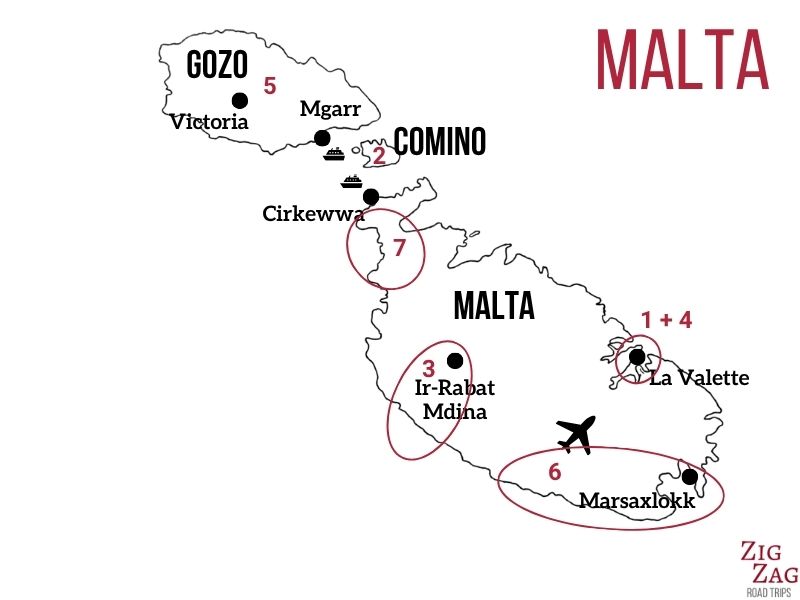
If you’d like to create your own itinerary, check out my article on the best attractions in Malta.
Getting around Malta
The bus network covers the entire main island, with Valletta serving as the central hub. Fares are affordable and allow you to reach most sites.
But I strongly recommend renting a car to see more and reach more isolated spots like the Dingli Cliffs or the southern temples.
Be aware, however: driving is on the left in Malta, a legacy of British rule. Roads can be narrow and signage is inconsistent.

My tips for renting a car in Malta
- Compare prices on Discovercars, my favorite platform and one of the highest-rated
- Book your car early for more options and better prices
- Don’t rent a car that’s too big, as the roads are narrow.
Read all my tips (coming soon)
Day 1 – Valletta, the fortified capital
For this first day, I suggest diving straight into the historic heart of Valletta. Founded in 1566 by the Knights of the Order of St John, the Maltese capital is a UNESCO World Heritage Site. I was struck by the density of monuments packed into its narrow streets running down to the harbour. The city is entirely walkable: you can cross it from end to end in 15 minutes. Every street corner holds a discovery, whether it’s a carved façade, a colourful wooden balcony or a Baroque church.
Morning: St John’s Co-Cathedral and the works of Caravaggio

Start your day with Valletta’s most striking monument: St John’s Co-Cathedral. Built between 1573 and 1578, its austere façade gives no hint of the profusion of decoration inside. The walls and ceiling are entirely covered with paintings, gilding and Baroque sculptures. The floor is made up of over 400 polychrome marble tombstones, those of the Knights of the Order.
I found the oratory particularly striking: it houses two major works by Caravaggio, the 17th-century Italian painter known for his revolutionary chiaroscuro style. The Beheading of Saint John the Baptist, the painter’s largest canvas, and Saint Jerome Writing were created during his stay in Malta in 1608. Allow about 1 to 1.5 hours for the visit.
Book a guided tour to better understand this monument – see options
Lunch and stroll through the historic centre
Continue your morning with a wander through the streets of Valletta. Republic Street and Merchant Street are lined with cafés, shops and restaurants where you can stop for lunch. I enjoyed being able to alternate between the main thoroughfares and the quieter side streets. If time allows, head to Mysterium Fidei, a former monastery whose atmosphere contrasts with the bustle of the rest of the city – book your entry.

Afternoon: the Grand Master’s Palace and the museums
The Grand Master’s Palace, on Republic Street, was the official residence of the leaders of the Order of St John, then of the British governor. Today it houses the office of the President of Malta. Some rooms are open to visitors, including the State Rooms adorned with frescoes, tapestries and armour. I found the armoury particularly interesting: it contains over 5,000 pieces tracing the evolution of military equipment from the 15th to the 18th century. Allow about 1.5 hours for the whole visit. The palace is undergoing gradual restoration – check which rooms are open before your visit. More information on the official website here.
Take advantage of the combined ticket with the art museum and the archaeology museum.
See alternatives further down in the article, under other museums.

Late afternoon: the Upper Barrakka Gardens and the sunset
To round off this first day, head to the Upper Barrakka Gardens. From this elevated terrace, the panorama over the Grand Harbour and the Three Cities is breathtaking. I went in the late afternoon, when the golden light illuminates the fortifications on the other side of the harbour. Every day at noon and 4pm, the Saluting Battery fires a cannon from the platform below – a ritual dating back to the 19th century. Access to the gardens is free. Afterwards, you can settle into one of the wine bars or terraces on the ramparts to enjoy the evening atmosphere.

Day 2 – Comino and the Blue Lagoon
Comino is the smallest of the three inhabited islands of the Maltese archipelago. Located between Malta and Gozo, it is virtually deserted: no cars, no paved roads. The island is mainly known for the Blue Lagoon, but it also offers beautiful walks for those who want to escape the crowds. Different types of boats can take you there – see options

Morning: the Blue Lagoon
The Blue Lagoon is arguably the most photographed natural site in Malta. This lagoon with turquoise, almost transparent water is framed by rocks and the islet of Cominotto. Swimming here is very pleasant – the sandy bottom allows you to clearly see the fish. However, the site is a victim of its own success: in high season (July-August), it can get very crowded from midday onwards. I found that before 10am or after 4pm, the experience is much more enjoyable. Sun loungers and parasols are available for hire on site, but they go quickly. Remember to bring your snorkelling gear. On the south coast of Comino, most boat trips also take you to the feet of the Santa Maria Caves, sea cavities carved into the limestone rock.

Afternoon: exploring the rest of the island
Beyond the Blue Lagoon, Comino offers wild and little-visited hiking trails. St Mary’s Tower, built in 1618, dominates the landscape and can be spotted from afar. Walking south, you reach Santa Marija Bay, quieter and bordered by a small beach. The island can be explored on foot in 2 to 3 hours. I enjoyed this wilder side of Comino, far from the bustle of the lagoon. Wear good shoes (the terrain is rocky), bring water and sunscreen, as there are no supply points. And no shade either!
Make sure to book in advance – it’s a popular excursion! See options


It’s time to book!
Compare everything: companies, prices, schedules, and availability.
Day 3 – Mdina, Rabat and the centre of the island
Mdina, perched on a hill in the centre of the island, is the former capital of Malta. Nicknamed “the Silent City”, it has retained a calm, timeless atmosphere. Behind its massive ramparts, narrow streets wind between golden limestone palaces and discreet churches. Fewer than 300 people still live here. I found the contrast striking between the bustle of Valletta and the almost surreal quiet of Mdina. Allow half a day to a full day to explore Mdina and the neighbouring town of Rabat.

Morning: getting lost in the streets of Mdina
The best way to discover Mdina is to let its streets guide you. The maze of cobbled lanes leads to hidden courtyards, vaulted passageways and unexpected views over the Maltese countryside. The limestone walls, weathered by centuries, take on golden hues in the sunlight. I found that every turn held a surprise: a sculpted door knocker, a religious niche, a wrought-iron balcony. Worth noting: several scenes from the series Game of Thrones were filmed here, which has boosted the city’s fame. Don’t miss St Paul’s Cathedral, built at the end of the 17th century in Baroque style. The ceiling frescoes by the Sicilian painter Mattia Preti create a striking perspective effect. The small adjoining museum displays silverware, illuminated manuscripts and Dürer engravings. Nearby, Bastion Square offers an open panorama over a large part of the island. – Buy your ticket for the cathedral.

Afternoon: Rabat and the Catacombs of St Paul
Just outside the walls of Mdina, Rabat is a lively town that’s well worth a stop. The Catacombs of St Paul form an underground network dug between the 4th and 9th centuries, among the largest in the Mediterranean. You’ll discover burial chambers, stone tables used for ritual meals (the agapae) and niches carved into the rock. The site gives a tangible insight into Late Antiquity burial practices. I found the site well laid out, with clear information panels. Nearby, St Paul’s Grotto marks the spot where, according to tradition, the Apostle Paul took shelter after his shipwreck in Malta in 60 AD. More information on the official website here.

Afternoon: Dingli Cliffs, the highest point in Malta
End the day at the Dingli Cliffs on the south-west coast. They rise to about 253m above sea level – the highest point on the island. A trail runs along the cliff edge for several kilometres, offering open views over the Mediterranean and the uninhabited islet of Filfla. The small Chapel of St Mary Magdalene, perched alone on the cliff edge, is an easily recognisable landmark. I found the spot ideal for a late afternoon walk, when the low-angled light colours the limestone walls. Access is free. In summer, bring water as there are no shops in the immediate vicinity of the trail.

Day 4 – The Three Cities and the military heritage
The Three Cities – Vittoriosa (Birgu), Senglea (Isla) and Cospicua (Bormla) – form a historic cluster facing Valletta across the Grand Harbour. Older than the capital, they were the first base of the Knights of the Order of St John in Malta in 1530. I found the atmosphere very different from Valletta: more local, less touristy. Crossing by dghajsa (traditional Maltese water taxi) from Valletta is a lovely way to arrive. You can also take the ferry from the Waterfront.
You can book a guided boat tour.

Morning: Fort St Angelo and the Vittoriosa waterfront
Start with Fort St Angelo (Forti Sant’Anglu), located at the tip of Vittoriosa. One of the oldest fortifications in Malta, it played a central role during the Great Siege of 1565, when the Knights held out against the Ottoman Empire’s assault for nearly four months. Now restored, the fort offers a route through bastions, guard rooms and the medieval chapel. From the ramparts, the view over the Grand Harbour and Valletta is remarkable. I found that the fort gave a good overview of the archipelago’s military history. Allow about 1 to 1.5 hours.
Then head down to the Vittoriosa Waterfront. The former storehouses of the Order have been restored and now house restaurants and terraces overlooking the marina. I enjoyed sitting there watching the moored yachts and the silhouette of Valletta on the other side of the harbour.

Afternoon: wandering through the streets of the Three Cities
Beyond the waterfront, the heart of the Three Cities is best discovered on foot. Vittoriosa is the richest in heritage: here you’ll find the Inquisitor’s Palace, one of the few inquisition palaces open to the public in Europe, along with Order auberges and discreet churches. Senglea has narrow residential streets brought to life by everyday activity, and the Gardjola Gardens offer a fine panorama from their position jutting out over the harbour. Cospicua, the largest of the three, is surrounded by the Margherita and Cottonera fortification lines. I enjoyed exploring these neighbourhoods without a set route, discovering architectural details and harbour views as I went.

Plan your unforgettable trip to Malta!

- maps to help you plan
- handpicked beautiful spots
- Practical information, including GPS coordinates
- photos to help you choose
COMING SOON
Day 5 – Gozo: Victoria, the Citadel and the Ġgantija Temples
Victoria (also called Rabat by Gozitans) is the main town of Gozo, the second island of the Maltese archipelago. Located in the centre of the island, it serves as its administrative and commercial hub. I found Gozo noticeably different from Malta: more rural, calmer, with a less hurried pace of life. Victoria deserves at least half a day, more if you take time to browse the shopping streets.
Most excursions to Gozo pass through the Citadel of Victoria – see options

Morning: the Citadel and the Cathedral of the Assumption
The Citadel of Victoria dominates the island from its fortified promontory. Inhabited since the Neolithic period, it was reinforced by the Knights of the Order in the 17th century. Until 1637, Gozitans had to take refuge here every night to protect themselves from pirate and corsair raids. Today, the ramparts offer a 360° panoramic view over Gozo and, on clear days, over Malta and Comino. Inside, several small museums are worth a stop: the archaeology museum, the folklore museum and the old prisons. I was impressed by the quality of the recent restoration. Access to the Citadel is free; the museums are ticketed (a combined ticket is available). More information on the official website here.
At the heart of the Citadel, the Cathedral of the Assumption is a fine Baroque building constructed between 1697 and 1711. Its most surprising feature is its ceiling: painted in trompe-l’œil by Antonio Manuele, it creates the illusion of a dome when the cathedral actually doesn’t have one (funds ran out before it could be built). The effect is astonishing when you stand in the centre of the nave. I found that the visit, which takes about 20 to 30 minutes, nicely rounded off the exploration of the Citadel.

Break on Republic Street
Republic Street (Triq ir-Repubblika) is Victoria’s main shopping street. Lined with shops, cafés and a few traditional bakeries, it’s the local meeting point. You’ll find local products such as goat’s cheese (ġbejna), Gozo honey and Maltese pastries. I enjoyed the relaxed atmosphere and the good value restaurants in the surrounding streets. It’s a pleasant spot for a break between visits.

Afternoon: the Ġgantija Temples
The Ġgantija Temples on the island of Gozo are among the oldest freestanding structures in the world (around 3600 BC), predating the Egyptian pyramids and Stonehenge. Their name comes from the Maltese ġgant (giant), as local legend attributed their construction to a giantess. The outer walls, over 5m high, are made of massive limestone blocks, some weighing over 50 tonnes. The adjacent museum displays objects found on site and explains the construction techniques. I found the site well presented since its renovation.
Allow about 1 hour for the visit.
Most excursions around Gozo include a stop at the temples – see options

Afternoon: Xwejni Salt Pans
To finish off on this island, a somewhat different landscape. On the north coast, the salt pans of Xwejni Bay form a geometric landscape sculpted into the coastal rock. These salt basins, in use since Roman times, are still active today. Some families continue the artisanal harvesting of sea salt, particularly between June and September. I found the spot very photogenic, with the rocks as a backdrop.
Access is free.

There’s more to see on Gozo: beaches, coves, cliffs, a basilica. You can extend this day or decide to spend a second one there. See ideas further down in the article.
Day 6 – Prehistoric temples and nature
For this last day, it’s back to the main island of Malta for a programme combining prehistoric heritage and coastal landscapes. I’ve put together a flexible itinerary, perfect if you enjoyed the atmosphere of Valletta the evening before or if your return flight is scheduled for late afternoon.
Morning: the temples of Ħaġar Qim and Mnajdra
The temples of Ħaġar Qim and Mnajdra, UNESCO World Heritage Sites, sit on the south coast of Malta overlooking the sea. Ħaġar Qim, built around 3600-3200 BC, impresses with the sheer size of its limestone blocks (some exceed 5m in length). Mnajdra, a few hundred metres downhill, is aligned so that sunlight illuminates the temple interior during the equinoxes and solstices. A small interactive museum at the site entrance puts the temples in context. I enjoyed the path linking the two temples along the cliffs, offering fine views of the uninhabited islet of Filfla. Allow 1.5 to 2 hours for the whole visit.
If you’d rather not drive, a few organised excursions will take you there – see options

Afternoon: the Dingli Cliffs and the Blue Grotto
The Dingli Cliffs on the south-west coast rise to about 253m above sea level – the highest point on the island. A trail runs along the cliff edge for several kilometres, offering open views over the Mediterranean and the uninhabited islet of Filfla. The small Chapel of St Mary Magdalene, perched alone on the cliff edge, is an easily recognisable landmark. I found the spot ideal for a late afternoon walk, when the low-angled light colours the limestone walls. Access is free.
If the weather allows, make a detour to the Blue Grotto, a cluster of sea caves accessible by traditional boat from the small harbour of Wied iż-Żurrieq. The trips last about 25 minutes. In strong winds or rough seas, trips are cancelled. A viewpoint above nonetheless offers an impressive view of the cliffs and natural arches, even without taking the boat. – See excursions.

Late afternoon: St Peter’s Pool, the natural swimming spot
And finish the day at St Peter’s Pool. Located in the south-east of Malta near Marsaxlokk, it’s a natural swimming pool carved into the limestone rock. The water is a deep blue, and the flat rocks around the pool serve as sunbathing spots. The more adventurous leap from the rocky ledges to dive in.
Access is free but there are no facilities (no toilets, showers or parasols). The path from the car park is a dirt track of about 10 minutes. Wear suitable shoes for the rocks.


My favorite activities in Malta:
- Boat trip to Comino Island and the Blue Lagoon – see options
- Kayaking excursions – see options
- Culinary tours – see options
- ATV tours – see options
Day 7 – Beach and surprising places
Morning: Popeye Village

Popeye Village (or Sweethaven Village) is a film set built in 1979 for Robert Altman’s film Popeye, starring Robin Williams. This colourful wooden village, clinging to the rocks of Anchor Bay, was never dismantled after filming. Now converted into a theme park, it offers entertainment, shows and water activities. I found the place more suited to families, but the set is photogenic, especially seen from the viewpoint above.
Stop at St Agatha’s Tower

St Agatha’s Tower (also known as the Red Tower, due to its ochre-red colour) is one of Malta’s most iconic watchtowers. Built in 1649, it is part of the network of coastal towers designed to monitor the shores and raise the alarm in case of attack. Situated on the heights of Mellieħa, it offers an expansive panorama over Mellieħa Bay, Comino, Gozo and the surrounding countryside. I found the walk up to the tower pleasant and the view from the rooftop terrace among the most open in northern Malta. The visit is short (about 20 to 30 minutes). A few euros entry.
Afternoon: Golden Bay beach

And we finish with some relaxation on the beach. Golden Bay is one of Malta’s most popular beaches, located on the north-west coast. Its golden sand and setting nestled between clay cliffs make it a photogenic spot, especially at sunset. The beach is supervised in season and has some facilities.
Alternative 1: with more museums
Art, culture and architecture enthusiasts can replace full or half days with the fascinating museums of Valletta.

- Fort St Elmo, at the tip of the peninsula, traces Malta’s military history and houses the National War Museum.
- MUŻA (National Museum of Fine Arts) presents diverse collections in a former palace.
- The National Museum of Archaeology displays remarkable pieces from Malta’s prehistoric temples.
- Merchant Street and Republic Street, where cafés and shops follow one after another.
- Mysterium Fidei, a monastery with a unique atmosphere – book your entry
Alternative 2: with more water activities
Maltese waters are among the clearest in the Mediterranean, with underwater visibility regularly reaching 30m. If you’d like to devote more time to sea-based activities, here are some suggestions to work into your programme:

Scuba diving is one of the archipelago’s great specialities. Among the renowned sites: the MV Karwela wreck off Gozo (a ferry deliberately sunk to create an artificial reef), the Blue Hole at Dwejra and the underwater caves of Comino. Dive centres offer introductory sessions and outings for all levels. Snorkelling is excellent at the Blue Lagoon on Comino, at Għar Lapsi, at St Peter’s Pool and in Xlendi Bay on Gozo. Sea kayak excursions let you explore caves and coves inaccessible by road, particularly around Comino and along the south coast of Gozo. Stand-up paddleboarding and jet-skiing are available at St Julian’s, Sliema and Mellieħa. – See options.
Alternative 3: with more beaches
Malta isn’t the first destination that springs to mind for beaches, yet the archipelago has several that are well worth a visit. Sandy beaches are relatively rare (the coastline is mostly rocky), which makes them all the more popular. I found that most are concentrated in the north of the main island and on Gozo. In high season, they fill up fast: arrive early to get a good spot. Here are my suggestions to work into your itinerary:

Besides Golden Bay on the north-west coast, you can also enjoy other beaches on the island of Malta:
- Mellieħa Bay (Għadira Bay) is the largest sandy beach in Malta.
- Paradise Bay, reached via steps carved into the rock, offers intensely blue water and a direct view of Comino and Gozo.
- Balluta Bay, where you can enjoy the beach and the architecture at the same time.
Gozo is also rich in beautiful beaches and coves.
Alternative 4: with activities for children
Besides the beaches, the forts and Popeye Village, you can also take your children to:
- Malta National Aquarium – book your ticket
- Playmobil FunPark – see the website here
- Splash & Fun Water Park, the island’s largest water park – see the website here
Alternative 5: Food tour
Malta has a strong cultural identity, shaped by centuries of Phoenician, Roman, Arab, Norman, Spanish, French and British influence. This diversity is reflected in the cuisine.
On the food front, try the pastizzi (flaky pastries filled with ricotta or peas, sold for a few cents in the pastizzerias), ftira (Maltese filled bread, similar to focaccia), rabbit stew (fenkata, the national dish) and goat’s cheese ġbejna.
The best introduction is to join a food tour in Valletta to better appreciate this culture – see options

Alternative 6: more on the island of Gozo
As mentioned above, you can extend your day on Gozo or plan a second one.
This way you’ll be able to discover:
- The magnificent Ramla Bay beach with its dark orange sand
- Pretty coves like San Blas, surrounded by vegetation
- Dwejra, a remarkable geological site. The Inland Sea is a natural lagoon connected to the Mediterranean by a tunnel carved through the cliff.
- The Sanap Cliffs on the south coast. These limestone cliffs, over 130m high, plunge vertically into the sea.
- The Basilica of Ta’ Pinu, a major pilgrimage site on Gozo, standing alone in the middle of the countryside
More ideas in my article on the best attractions in Gozo.

Good to know for your stay in Malta
The weather in Malta
Spring (April-June) and autumn (September-November) offer the best conditions: pleasant temperatures (20 to 28°C), moderate crowds and lower prices. Summer (July-August) is very hot (35°C and above) and popular sites like the Blue Lagoon are packed.
Winter (December-March) is mild (12 to 18°C) but some days can be rainy and windy. On the other hand, it’s the quietest period for visiting the historic sites.

Crowds in Malta
In high season (July-August), the most popular sites such as the Blue Lagoon, Valletta and the northern beaches can be very crowded. Spring and autumn are ideal periods to combine pleasant weather with moderate visitor numbers. If you’re taking your holiday in summer, remember to book your accommodation in advance and visit the most popular sites early in the morning.
Adapting your itinerary when it rains
If rain makes an appearance during your stay in Malta, don’t panic – the archipelago is full of sheltered sites. You can visit the Ħal Saflieni Hypogeum, explore Valletta’s museums or St John’s Co-Cathedral. The Lascaris War Rooms and the catacombs of Rabat are also good options for a rainy day.
Plan your trip to Malta!
- Things to do in Malta (coming soon)
- Most beautiful churches (coming soon)
- Rent a car in Malta (coming soon)
- When to visit Malta (coming soon)
- Where to stay in Malta (coming soon)
Plan your unforgettable trip to Malta!
- maps to help you plan
- handpicked beautiful spots
- Practical information, including GPS coordinates
- photos to help you choose
COMING SOON


