Want to plan enough days to discover the Maltese archipelago without missing anything?
Here are all my tips for choosing how many days to spend in Malta based on your expectations.
// On this page, no sponsored content. Just a few affiliate links.
// If you use them, I’ll get a commission at no extra cost to you (read more).
How many days to spend in Malta: quick answers
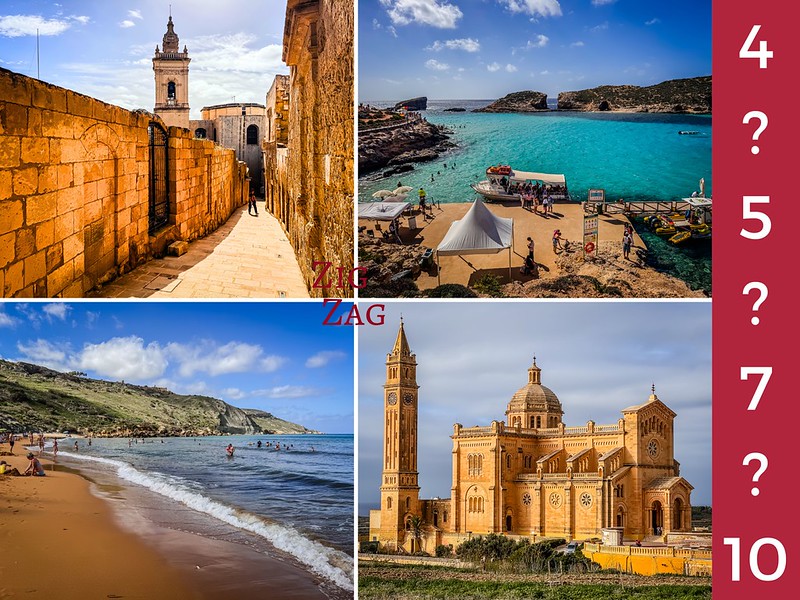
- Minimum for a first glimpse of the main island: 3 days
- Number of days to see all the most famous spots in Malta and Gozo: 5 to 7 days
- Ideal number of days to truly enjoy it, in my opinion: 7 to 10 days
- If you simply want to spend time at the beach… it depends on how many days you have available and your budget
There is no universal answer to this question. It depends on many criteria. I give you more details in this article to help you make your decision.

The Maltese archipelago is made up of three islands:
- Malta holds the majority of historical sites and infrastructure
- Gozo offers a more rural pace and remarkable coastal landscapes
- Comino, the smallest, is mainly known for the Blue Lagoon.
I recommend planning time for at least two of the three islands, but all 3 are worth visiting!
Number of days to see the must-visit sites
In my opinion, the truly must-visit places are:
- Valletta, the fortified capital and UNESCO World Heritage Site: St. John’s Co-Cathedral, Grand Master’s Palace, Upper Barrakka Gardens
- Mdina, Malta’s former medieval capital, and neighbouring Rabat
- The Three Cities (Vittoriosa, Senglea, Cospicua), historic quarters facing Valletta
- The megalithic temples, among the oldest free-standing stone structures in the world (older than the Egyptian pyramids)
- The ĦHal Saflieni Hypogeum, a unique underground Neolithic temple (booking required, very limited spots)
- The cliffs and caves
- The island of Gozo: the Citadel in Victoria, Ggantija Temples, Marsalforn salt pans, Ramla Bay
- The Blue Lagoon in Comino, a lagoon with turquoise waters
I think that in 5 to 7 days, you can comfortably cover the most famous sites in Malta and Gozo. To add Comino and relaxation days, plan for 7 to 10 days instead.
Learn more in my article about the best attractions in Malta.


Where to Stay in Malta – My Favorite Spots:
- Valletta – See best-rated accommodations
- St. Julian’s – See best-rated accommodations
- Victoria (Gozo Island) – See best-rated accommodations
My Top Picks:
- Cugo Gran Macina (5 stars) – see photos and availability
- The Gomerino Hotel (4 stars) – see photos and availability
See my article on the best places to stay in Malta (coming soon)
Size and driving times
The island of Malta is compact: roughly 27 km long by 14 km wide. Distances are short, but road traffic can extend travel times, especially around Valletta and Sliema during rush hour. I’ve found that allowing a little extra time is always wise.
Gozo is even smaller, about 14 km by 7 km. Once there, everything is easily reachable within a 20 to 30-minute drive.
Here are the main driving times to give you an idea:
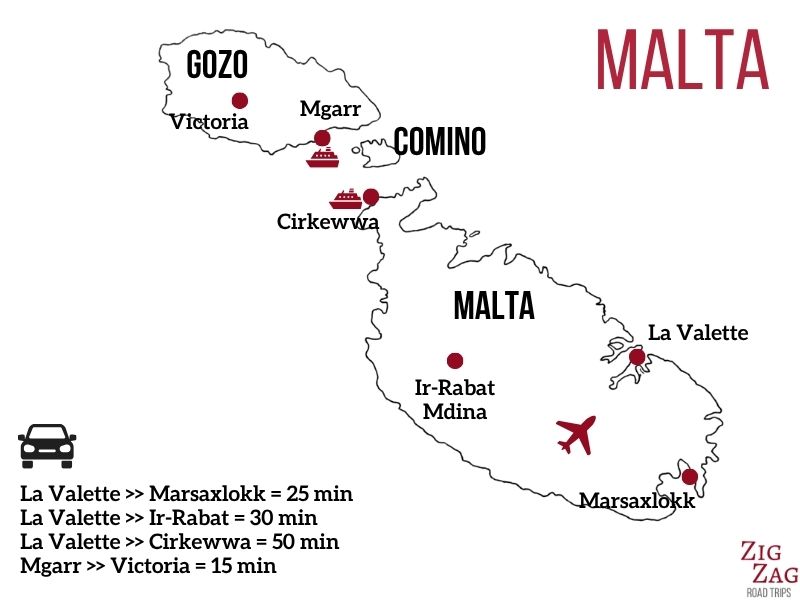
- Valletta → Mdina: about 25 min
- Valletta → Marsaxlokk: about 25 min
- Valletta → Blue Grotto (Wied iż-Żurrieq): about 30 min
- Valletta → Hagar Qim: about 30 min
- Valletta → Mellieħa: about 30 min
- Valletta → Cirkewwa ferry terminal (for Gozo): about 40 min
- Ferry crossing Ċirkewwa → Mġarr (Gozo): about 25 min
Public buses cover most of the island of Malta and are an affordable alternative to renting a car. The network is centralised around Valletta: most routes start from or pass through the bus terminal located at the gates of the capital. On Gozo, local buses serve the main sites from the terminal in Victoria.
3, 5, 7 or 10-day itineraries
To get an even better idea of what you can see, check out my itinerary suggestions:
- 1-week itinerary
- 10-day itinerary (coming soon)
- 5-day itinerary (coming soon)

My tips for renting a car in Malta
- Compare prices on Discovercars, my favorite platform and one of the highest-rated
- Book your car early for more options and better prices
- Don’t rent a car that’s too big, as the roads are narrow.
Criteria for deciding how long to stay in Malta
Budget
Evaluate the total amount you can afford — this will help you figure out how many days you can stay.
Malta is generally cheaper than most Western European destinations for accommodation and dining, which makes it possible to extend your stay a little on the same budget. Seaside hotels in Sliema, St. Julian’s or Mellieħa offer a range of prices, from hostels to upscale properties. I’ve found that prices remain reasonable outside of the summer high season.
- Learn more about car rental in Malta (coming soon)
- See my article: where to stay in Malta to check the prices (coming soon)
Hotel price ranges vary enormously between hostels, apartments, boutique hotels and 5-star establishments. I therefore can’t give you an exact price — look up the rates for your preferred type of accommodation.

Your interests, desires and goals
Spending time at the beach? Diving into history? Going scuba diving?
Your interests affect the time you need to make the most of the destination.
For example, a deep cultural immersion may require more days than a quick beach getaway.
In Malta, the offering is particularly rich for the size of the archipelago. I was surprised by the density of sites to discover in such a small area.
- Number of cultural and historical sites:
very high (Neolithic megalithic temples, fortifications of the Order of St. John (16th–18th centuries), cathedrals, museums, World War II sites) - Number of characterful towns and villages:
high (Valletta, Mdina, Vittoriosa, Marsaxlokk, Victoria in Gozo) - Number of beautiful beaches and coves:
moderate (Golden Bay, Mellieha Bay, Ramla Bay in Gozo, Blue Lagoon in Comino). Sandy beaches are fewer in number than rocky sea access points

- Number of boat trips:
high (Blue Grotto, Comino, coastal tours, harbour cruises) - Number of dive sites:
very high (wrecks, underwater caves, reefs). Malta is one of the best diving destinations in the Mediterranean - Number of hikes:
moderate, mainly along the cliffs (Dingli Cliffs) and in Gozo


My favorite activities in Malta:
- Boat trip to Comino Island and the Blue Lagoon – see options
- Kayaking excursions – see options
- Culinary tours – see options
- ATV tours – see options
Visa
Malta is part of the Schengen Area. If your passport is from outside the Schengen Area, the standard tourist visa allows you a maximum of 90 consecutive days to travel within the area, including Malta.
For non-European travellers: starting in 2026, all citizens from visa-exempt countries (United States, Canada, United Kingdom, Australia, etc.) will need to obtain ETIAS authorisation before entering the Schengen Area, including Malta.
Plan to submit your application several days before your departure to avoid any last-minute stress.
Weather, conditions, events
The season influences your experience in Malta, even if it doesn’t impose strict constraints on the length of your stay.
In summer (June to September), temperatures regularly exceed 30°C and the sun is intense. Outdoor sites like the Hagar Qim temples or the narrow streets of Mdina are more comfortably visited in the morning or late afternoon. This is also the time when the Blue Lagoon in Comino is very crowded: I’ve found that arriving early in the morning or visiting on a weekday makes a real difference.
Spring (March to May) and autumn (October to November) offer pleasant temperatures for combining cultural visits and swimming. In my view, this is the best time for a well-rounded trip.

In winter (December to February), the archipelago remains mild compared to the rest of Europe (averaging 12–16°C), but swimming is off the agenda for most visitors. A few rainy days are possible. On the other hand, it’s an excellent time for historical and cultural visits, away from the summer crowds.
Worth noting: Malta hosts several events that can enrich a stay, such as Carnival (February), the Festa (village festivals in summer, nearly every weekend), or the International Fireworks Festival (April). Check the events calendar before setting your dates.

Plan your unforgettable trip to Malta!

- maps to help you plan
- handpicked beautiful spots
- Practical information, including GPS coordinates
- photos to help you choose
COMING SOON
Frequently asked questions
Are 3 days enough in Malta?
With 3 days, you can discover Valletta, Mdina and one or two other major sites on the island of Malta. It’s enough for a first overview, but too short to include Gozo or enjoy the beach.
Are 5 days enough in Malta?
With 5 days, you have enough time to explore Malta’s main sites and dedicate a full day to Gozo or Comino. The pace remains brisk if you want to cover everything, but it’s doable.
Is 7 days too long in Malta?
No, 7 days is not too long. In my opinion, it’s the right balance for visiting Malta, Gozo and Comino without rushing, while fitting in swimming breaks or diving. Despite the small size of the archipelago, the density of historical sites and coastal landscapes easily fills a week.
Is 10 days too long in Malta?
No, 10 days is not too long if you like to take your time. You’ll be able to explore all three islands in depth, revisit places you enjoyed, try local restaurants and include activities like diving or a hike along the Dingli Cliffs. I’ve found that this pace also allows you to soak up the local atmosphere without feeling rushed.
Plan your trip to Malta!
- Best things to do in Malta
- Best things to do in Gozo
- Most beautiful churches (coming soon)
- Rent a car in Malta
- When to visit Malta (coming soon)
- Where to stay in Malta (coming soon)
- Itineraries: 1 week
Plan your unforgettable trip to Malta!
- maps to help you plan
- handpicked beautiful spots
- Practical information, including GPS coordinates
- photos to help you choose
COMING SOON


